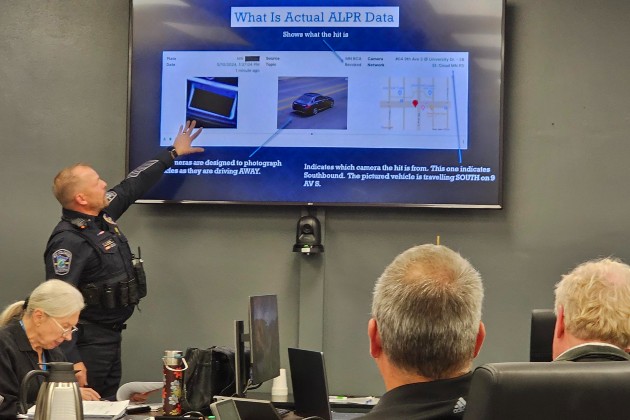
(KNSI) – St. Cloud Police Chief Jeff Oxton told a packed City Council work session Monday that the city’s license plate reader cameras are a key public safety tool, while at least one council member says the bigger question is where the technology goes from here.
Asked where the cameras fit in his department’s work, Oxton didn’t hedge. “I think ALPR is an incredibly valuable tool to help us provide public safety.”
Oxton says the technology is endorsed by groups including the National Center for Missing and Exploited Children, the Jacob Wetterling Resource Center, the Minnesota Sheriffs’ Association and the Minnesota Chiefs of Police Association.
Oxton used part of his presentation to show the council what the cameras actually capture when a car drives past. “It’s very simple. It’s a license plate, a picture of the back of a car, the date and time where it was seen in the location, and that’s it.”
Council Member Mark Johnson says he’s comfortable with how the cameras are used now. He says the program needs to be closely monitored, and the city should act quickly if there’s any misuse or hacking. “I think one of the biggest things is not so much how they’re being used now, but what future technology may, what options that may make and how we will protect people’s privacy with those increases in technology.”
Mayor Jake Anderson said during the meeting that Flock had been working on voice recognition technology, but recently dropped the idea over Fourth Amendment concerns. Flock ended a trial of an audio feature this summer that listened for signs of distress, such as screaming, saying the decision followed community feedback.
Council members agreed there’s a bank of trust between the community and police, and that the cameras could erode some of it.
Oxton says the department now keeps Flock camera data for seven days instead of 30, following Flock’s guidelines. Data from the Axon cameras is kept for 60 days, a limit set by state law. The city also audits its use of the cameras every month to make sure it follows state rules, a practice that started as a recommendation from the program’s state-required audit.
The department posts public data pages for both of its plate reader systems. The Flock transparency portal covers the stationary cameras, and a separate page covers the Axon cameras. Both are linked from the police department’s website, along with the department’s policies.
Oxton says neither system has been hacked. The data is kept in cloud storage through Amazon Web Services, which he says is about as secure as it gets.
The five stationary Flock cameras cost $15,000 a year. The five stationary Axon cameras cost about $12,500 a year, and plate readers in 37 squad cars cost $22,500 a year.
Other agencies have used the technology to find kidnapping victims and murder suspects. In St. Cloud, Oxton says it has mostly turned up traffic violations, like driving with a revoked license or without insurance. The city first used plate readers in 2015 on two squad cars and expanded their use in 2024 as the technology improved.
The police department does allow officers to use facial recognition software under a policy in place since March of 2023. That is a separate policy and program from the plate readers, and it was not part of Monday’s presentation or discussion.
Several Minnesota agencies have recently ended or paused their plate reader programs, including Sherburne County, which shut off its Flock cameras in August.
The presentation and discussion lasted about 45 minutes. Oxton says the goal was to get the council on the same page. No action was taken, and the council plans to discuss the issue again at a date not yet set.
The work session was open to the public, but it was not a public hearing, so residents did not get to speak. Johnson encouraged people to keep sharing their concerns with the council as the discussion continues.
___
Copyright © 2026 Leighton Media. All rights reserved. This material may not be broadcast, published, redistributed, or rewritten, in any way without consent.





FOLLOW US FOR INSTANT UPDATES!


FOLLOW US FOR INSTANT UPDATES!