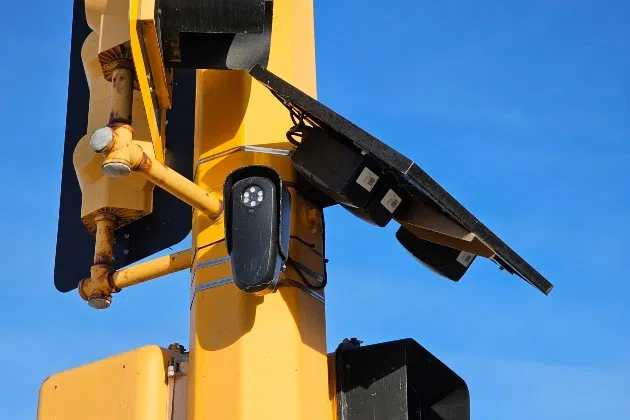
(KNSI) – St. Cloud police will lay out how the city uses its license plate reader cameras when the City Council meets in a work session Monday, a briefing Mayor Jake Anderson says he wants on the record before the council takes up the issue.
“So much of what goes on with any of these topics, whether it’s automatic license plate readers, data centers, etc., seems to be done in this vacuum of lacking information. And so then folks fill in what they hear other places anecdotally or what they read other jurisdictions doing or not doing.”
Anderson says he’s going into the session without a position. He sees the cameras as useful in cases like stolen vehicles and kidnappings, but acknowledges the concerns that have followed the technology in other cities.
“We do have, obviously, our personal liberties and freedoms. So we don’t want to be infringing upon those. But how do we balance that with attempting to provide the public safety folks come to expect?”
Police Chief Jeff Oxton laid out the program in two August memos to the mayor and city administrator, writing that much of the recent talk about the technology is based on inaccurate information. He says the plate readers log plates and vehicle descriptions. They do not use facial recognition, record audio, photograph drivers or passengers, or enforce speed limits.
The city has 10 fixed plate reader cameras, twice as many as a year ago. Five Flock cameras have run since March of 2024, four at 9th Avenue South and University Drive and one downtown at 5th Avenue and 1st Street South. Five Axon cameras went up on major St. Cloud bridges in June. About 39 marked squads also carry in-car readers. The crowdsourced site DeFlock lists 18 readers in the city.
Flock costs $15,000 a year. The Axon bridge cameras were added to the department’s existing Axon contract, which also covers Tasers, body cameras and other equipment. The costs come out of the police budget, including replacing vandalized cameras. St. Cloud and Sartell police have reported at least four damaged cameras, and an 18-year-old Sauk Rapids man was charged in August with cutting one down in downtown St. Cloud. He has not been convicted.
An independent audit, completed before the bridge cameras went up, found in-car cameras logged more than 1 million plate reads over 60 days. A public data page the department keeps for its Axon cameras showed about 4.3 million reads on file as of Friday, and more than 27,000 hotlist hits in the last 30 days. About 87% of those hits were for revoked, cancelled or suspended licenses. Fewer than 300 involved stolen vehicles or plates, and two involved missing persons. Officers have to confirm a hit and have their own reason before pulling anyone over.
The auditor found the program follows state law and that data is deleted on schedule, after 30 days for Flock and 60 for Axon. The department has turned off Flock’s data-sharing feature and has not received any outside requests for its data. The audit did recommend supervisors regularly review who is running searches and why.
Since the start of 2025, police say the readers have led to about 50 citations for license violations, recovered stolen vehicles, and helped locate suspect vehicles in hit-and-run crashes and a vehicle tied to a homicide.
The review comes as a growing number of Minnesota agencies back away from plate readers. Sherburne County shut off its Flock cameras in August, citing public trust, and Duluth is letting its contract expire this month. Isanti County and the cities of West St. Paul, Columbia Heights, Brooklyn Park and Shorewood have also ended or paused their programs.
While the plate readers do not use facial recognition, the police department has allowed the use of facial recognition software under a separate policy since March of 2023. The policy, approved by Oxton, lets officers use the software to help identify suspects, witnesses, victims and people who can’t identify themselves. It names Verkada Command camera software, or similar software, as a tool officers can use to track a person they have reasonable suspicion committed a crime or who has a warrant. Each use must be approved by a sergeant, and a match is treated as an investigative lead, not grounds for an arrest. The policy bars using the software for personal reasons or to target people based on race, religion, political views or other protected traits. The memos sent ahead of Monday’s work session do not mention the policy.
The work session starts at 4:30 p.m. Monday, September 21st, at St. Cloud City Hall. It is open to the public but is not a public hearing, so there will be no comment period.
___
Copyright © 2026 Leighton Media. All rights reserved. This material may not be broadcast, published, redistributed, or rewritten, in any way without consent.





FOLLOW US FOR INSTANT UPDATES!


FOLLOW US FOR INSTANT UPDATES!