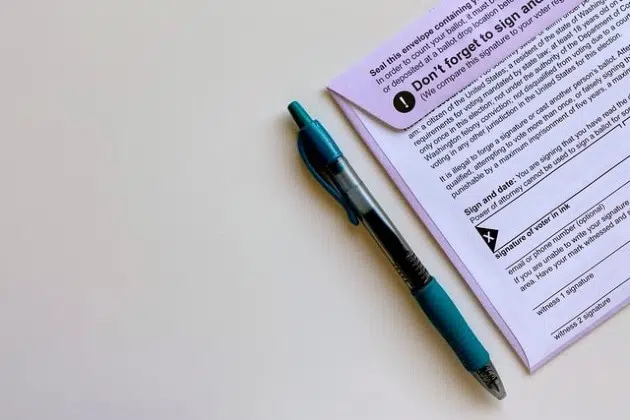
(KNSI) — Complaints about conduct in the 2024 St. Cloud City Council at-large race reached Stearns County election officials by late July 2024, weeks before the August primary and months before a double vote in Sherburne County triggered the investigation KNSI first reported in May.
Stearns County Sheriff’s Office records obtained by KNSI News center on the race in which Hudda Ibrahim, now the Ward 3 council member, competed for one of three seats. One report documents a formal complaint filed by a rival candidate accusing Ibrahim’s campaign, and specifically her husband, of pressuring voters at St. Cloud’s main early voting site. Two more reports, from the spring of 2025, detail the felony double-voting arrests of a St. Cloud man and his wife, who told investigators through a translator that strangers drove them to the polls, filled out their paperwork, and, in at least one case, marked their ballots for them.
No report identifies who assisted the couple, and nothing in the records connects their votes to Ibrahim, her husband, or any campaign.
The investigator who arrested the wife drew the connection to the political climate anyway. He wrote that he told the couple’s daughter St. Cloud had a heated city council race between two Somali community members, and that he had heard several complaints about people influencing voters.
Sherburne County investigators identified Tajir Rage, Ibrahim’s husband, as a man who regularly brought groups of Somali voters to absentee voting locations. They noted in passing that Stearns County staff had been dealing with voter assistance issues since July 2024, but never said what those issues were. These records do.
The Stearns County file opened with a complaint from inside the race itself.
Omar Abdullahi Podi, one of 16 candidates in the at-large primary, submitted a Minnesota State Election Law Complaint Form alleging that Ibrahim’s campaign team was blocking the doors at the Lake George early voting location and telling voters they could only vote for one person, and that the person should be Ibrahim. He also claimed campaign supporters were telling voters he had dropped out of the race.
Podi identified one of the people approaching voters as Ibrahim’s husband, whom he knew only as “Abdi.” The Sherburne County investigation later established that Rage gave the name Abdi Mahad to a deputy before his real identity was confirmed.
According to the Stearns County report by Investigator Scott Romstad, Podi alleged that Ibrahim’s husband waited inside the polling location at 1101 7th Street South and approached voters as they walked in, offering help and telling them they needed to vote for Ibrahim. Podi claimed the husband called one Somali woman 21 times to tell her who to vote for and grabbed three Somali women by the arm. He also claimed a person from the husband’s family used another voter’s ballot to vote.
Elections staff confirmed the polling place had become contested ground between the two campaigns.
Roxanne Gerads and Laura Laudenbach of the Stearns County Auditor-Treasurer’s Office told Romstad they first received Podi’s complaint in late July 2024, weeks before the August 13th primary. Laudenbach and a representative of the St. Cloud City Clerk’s Office met with Rage at the polling location on the morning of July 26th, 2024, and walked him through Minnesota’s voter assistance statute. She said he told her he was aware of the rules and mentioned he was writing a book about voting and voter suppression.
The complaints kept coming. Gerads and Laudenbach said they received a call from Elizabeth Boyles of the DFL Voter Alliance, relaying a complaint from a voter who claimed interpreters were telling people who to vote for. Gerads spent the day at the polling location on August 10th, 2024, the day that complaint came in, making sure the rules were followed, though she said she and the other election judges could not understand what was being said to voters in Somali.
After the Minnesota Secretary of State’s Office advised that interpreters could be removed and could not wait inside a polling place to approach voters, Gerads and Laudenbach went to Lake George on August 12th, 2024, the Monday before the primary, and delivered that message to roughly ten interpreters connected to both the Ibrahim and Podi campaigns. Rage was among them.
Romstad’s investigation of Podi’s specific allegations stalled on a familiar problem: no firsthand witnesses.
On September 17th, 2024, Podi emailed Romstad the names of four people he said the investigator should talk to. They were Faiisa Abdullahi, Najma Abukar, Todd Preib, and a woman he identified as Fartun B. Romstad attempted to reach all of them, and the report documents how each contact played out.
Faiisa Abdullahi returned his call the next day. Romstad wrote that she seemed hesitant and nervous and had no idea an investigator would be calling her, even though Podi had made it sound as if he had already spoken with the people on his list. She told Romstad she had overheard individuals telling voters who to vote for inside the polling location, but she could not provide any specific statements or say who the people were. She said she was only a volunteer who had been told they could be in the polling location to help voters, and at one point asked whether the matter was going to get out to the public. Romstad advised her that if she continued helping with voting, she needed to get a clear understanding from an election judge of what is and is not allowed inside a polling place.
Fartun B., identified in full in the report as Fartun Mahamud Ahmed, called back on September 19th, 2024. She said she had been approached by people asking who she was voting for and she told them her vote was a secret. She also said she saw and heard people telling other voters, both inside and outside the polling location, that they needed to vote for Ibrahim. But she could not name anyone doing the approaching or anyone being approached, and she, too, asked whether she was in trouble or whether her statement would become public.
Najma Abukar never called back. Romstad wrote that he left messages for everyone he had a working number for, and the report documents no response from her.
Reaching Todd Preib took longer. Podi provided no phone number for him at first, Romstad could not locate one, and the first number Podi eventually supplied did not work. A working number arrived on September 25th, 2024, and Romstad reached Preib the next day. Preib said he had been at the DFL office in St. Cloud when Podi, a friend of several years, came in to make his complaint, and he decided to go see the situation at Lake George for himself. He said he saw a man he later learned was Ibrahim’s husband standing just inside the building entrance, next to the room where voting was taking place, and that a Somali interpreter told him the husband was telling people to vote for Ibrahim. But Preib said the interpreter mentioned nothing about promises or threats, noted that Podi and Ibrahim had some bad history he did not fully understand, and told Romstad he was unsure whether what the husband was doing was illegal, though it appeared unethical.
The records show Podi never uploaded the photos and videos he claimed to have, even after being sent a link to do so in September 2024.
And the file cuts both ways. It contains an email chain from a person identified in the file as Skylar Sutton, accusing Podi himself of approaching voters at the polling location, assisting them in voting, and misinforming them about how many times they could vote. Laudenbach responded by asking Sutton to fill out an election complaint form. No form was ever returned.
Romstad concluded that no one he spoke with had direct information that anyone at the polling location influenced any voter’s decision, and that nothing supported the claim that anyone voted with another person’s ballot.
The case, which listed a misdemeanor polling place misconduct statute, was forwarded to the Stearns County Attorney’s Office and marked inactive. As KNSI previously reported, Stearns County Sheriff Steve Soyka said his office turned its voter fraud findings over to the county attorney and no charges were filed.
Ibrahim, through her attorney, has previously told KNSI News that law enforcement reviewed the allegations against her campaign and found no wrongdoing, that providing rides to polling places is legal, and that no one was coerced or directed to support any candidate.
The polling place at the center of Podi’s complaint surfaced again the following spring.
In March 2025, the Auditor-Treasurer’s Office referred two cases to the county attorney after state voter registration records showed a husband and wife had each voted twice in the November 5th, 2024, general election. Gerads was listed as the requester on the referral.
The paper trail on 73-year-old Abdikadir Abdullahi Farah showed he voted in person by absentee ballot at the St. Cloud Municipal Complex on September 23rd, 2024, then completed a same-day registration under a new address at 6:16 p.m. on election day and voted a second time at Grace United Methodist Church in Ward 4, Precinct 4. His wife, 64-year-old Rukio Hirsi Ali, also voted twice, casting her first ballot at the Lake George facility, the same site named throughout the Podi complaint, and her second on election day.
Both were taken into custody on April 21st, 2025, on suspicion of violating Minnesota’s prohibition on voting more than once in the same election, which is a felony.
The couple’s statements to investigators are where their cases fold back into the larger story.
In recorded interviews with a Somali interpreter present, Ali said a person she did not know brought her to Lake George, where a Somali man filled out her paperwork and then marked the ballot itself. She said nothing was ever explained to her. She said the address written on her absentee application was one where she had never lived, that the handwriting on the form was not hers, and that she had handed over her Minnesota ID and Social Security card to the person filling it out. At her second stop, she said, a different man made all the selections on her ballot.
Farah said a person gathered up several individuals to go vote and he was one of them. He did not know where he voted. He said someone else completed his paperwork and that he was told to sign and then leave. Shown the signature envelope from his absentee ballot, he said the signature did not look like his. Both said they do not read, write, or speak English.
Romstad wrote that he told the family the people helping them were likely not with the government, and that he was aware of other complaints in which individuals in the Somali community were trying to help voters and were not looking out for the voters’ interests. It was then, according to his report, that he raised the council race with the couple’s daughter and urged her to make sure her parents only vote with people they trust.
The Stearns County records add to the picture that emerged from Sherburne County, in which voter assistance, including rides, interpreters, and help with paperwork, repeatedly drew the attention of election officials and investigators across county lines. In Sherburne County, an investigator wrote that he believed election law violations had occurred as part of an ongoing pattern of activity by individuals connected to Ibrahim’s campaign. In Stearns County, a rival’s complaint produced no charges, while two voters whose descriptions echo that pattern were arrested for double voting and described a process they say was never explained to them.
Whether those violations were unknowing, unintentional, or deliberately intended to affect the election outcome is the question the Sherburne County investigator said still needed answering. The Stearns County reports do not answer it either.
Ibrahim currently represents Ward 3 on the St. Cloud City Council. All four ward seats are on the ballot this fall.
___
Copyright © 2026 Leighton Media. All rights reserved.



FOLLOW US FOR INSTANT UPDATES!


FOLLOW US FOR INSTANT UPDATES!