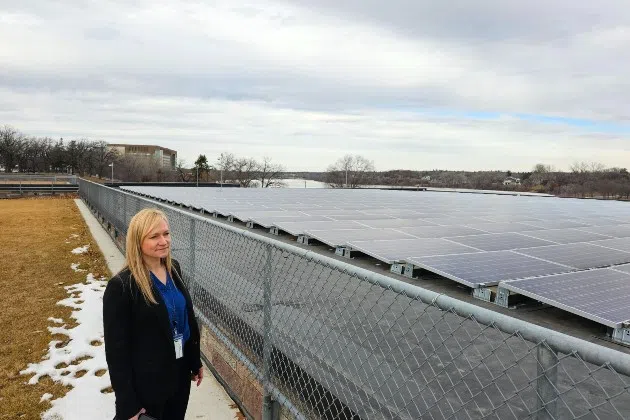
(KNSI) – As the world marks Earth Day today, Wednesday, April 22nd, the City of St. Cloud is celebrating more than a decade of green energy progress and setting its sights on two ambitious carbon-neutral goals.
St. Cloud City Administrator Tracy Hodel told KNSI News the city’s municipal buildings are already fully powered by renewable energy.
“As a city, because of the community solar garden subscriptions we have, we are net zero. So 100% of our city demand for electricity is provided by renewable energy, either by solar or biofuel across the whole city.”
That milestone comes from a mix of on-site solar, community solar garden subscriptions, and biogas generated at the wastewater treatment facility. The city currently operates 14 solar arrays on public buildings and property, with two more coming online at the Municipal Athletic Complex and the wastewater treatment facility, bringing the total to 16.
St. Cloud’s solar journey began in 2015 with a 20-kilowatt rooftop system at the wastewater treatment facility, affectionately known as the “baby solar.” That led to a 220-kilowatt system in 2016, and the program has grown ever since. Hodel says reaching 100% renewable municipal operations by 2020 once seemed like a stretch, but the city got there anyway.
Now St. Cloud is looking beyond its own operations. The city has set a goal of making the entire community carbon neutral on the electrical side by 2028, with a more ambitious target of carbon neutrality in the transportation and heating sectors by 2038. “We’ve been recognized not just on a local level, state level, national level, but globally for the work that we’re doing,” Hodel said.
She says the 2028 electrical goal is achievable in part because of aggressive renewable targets being pursued by Xcel Energy, which serves the majority of St. Cloud.
The 2038 goal is a steeper climb. To address it, the city is working on a green hydrogen project with researchers at the University of Münster in Germany and collaborators in Northern Ireland. St. Cloud is also partnering with the University of Minnesota to explore whether compressed natural gas engines, like those in Metro Bus’s fleet, could be retrofitted to run on a hydrogen blend.
A food waste-to-energy pilot program with St. Cloud School District 742 and Stearns County is also already underway. Food scraps from the district are diverted from landfills and processed at the wastewater treatment facility, producing biogas that powers on-site generators. Hodel says roughly 18% of landfill content is food waste, and about 58% of landfill methane emissions come from it.
Public Services Director Luke Langner says residents play a critical role in reaching these goals. “We’ve been talking a lot with Xcel Energy about different rebates and things like that as a potential of even putting solar on your roof yourself, and doing an interconnect back to assist the grid. When you’re away at work, your solar’s still working and can feed the grid.”
He also encourages residents to recycle household oils and greases at city drop-off locations and to conserve energy where they can.
Hodel says the city’s energy initiatives are also delivering financial benefits, helping stabilize property taxes and utility rates while protecting the environment.
___
Copyright © 2026 Leighton Media. All rights reserved. This material may not be broadcast, published, redistributed, or rewritten, in any way without consent.


FOLLOW US FOR INSTANT UPDATES!


FOLLOW US FOR INSTANT UPDATES!