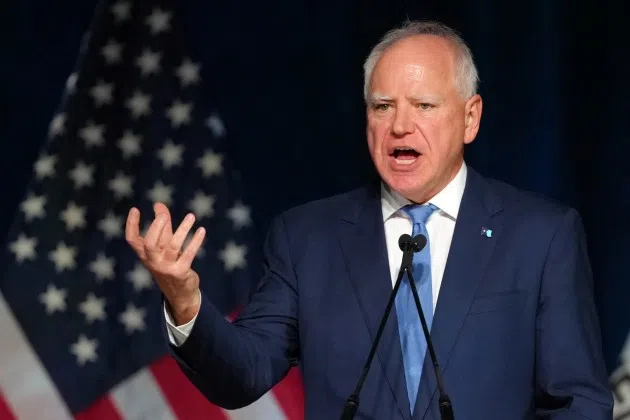
(KNSI) – Minnesota Governor Tim Walz released his supplemental budget on Tuesday, a mid-course update to the state’s two-year spending plan.
According to data released by the governor’s office, Minnesota currently has about $3.7 billion in its general fund. Under the plan, that drops to roughly $1.8 billion. The state has until June 30th to pass a final budget or face a government shutdown.
About 104,800 families with young children would receive larger child care tax refunds. First-time homebuyers, renters in crisis, and people needing stable housing would share $100 million in assistance. The statewide sales tax rate would drop slightly, the first cut in state history, but the tax would expand to cover some services provided by bankers, investors, and lawyers.
A new statewide Office of Inspector General would serve as a dedicated watchdog across all state agencies. Billing rules for disability and mental health services would be tightened, projected to save roughly $292 million over two years. The Attorney General’s Medicaid Fraud Unit would get more investigators, and penalties for stealing from public programs would increase.
The budget also responds to Operation Metro Surge, the federal immigration enforcement operation that disrupted thousands of Twin Cities families and businesses. The plan proposes $33 million in rental assistance for about 9,150 renters, $10 million in partially forgivable small business loans, and $10 million in a flexible fund for ongoing needs.
A new tax on firearms and ammunition would raise an estimated $28 million for prevention programs. The package also includes banning assault-style rifles, requiring firearm insurance, closing the ghost gun loophole, and $15 million for school safety grants.
On the cuts side, disability services would be reduced by more than $120 million over two years. Nursing home reimbursement rates face new oversight rules saving around $57 million. Metro Transit’s state subsidy would be cut by $40 million.
Speaker Lisa Demuth welcomed the fraud focus but said Republicans want those savings used for tax relief, including no tax on tips, no tax on overtime, and lower car tab fees.
Senate Minority Leader Harry Niska criticized Walz for raising taxes while cutting nursing home funding, calling it the wrong direction for a state where costs are already too high.
Ways and Means Chair Paul Torkelson said cuts to nursing homes and new taxes on legal services will face strong resistance, but he identified the Office of Inspector General, IT modernization, and Medicaid compliance as areas where both parties could work together.
Two Republican health committee chairs echoed that sentiment, calling Medicaid compliance urgent and warning that delays risk billions in federal funding that Minnesotans rely on.
___
Copyright © 2026 Leighton Media. All rights reserved. This material may not be broadcast, published, redistributed, or rewritten, in any way without consent.





FOLLOW US FOR INSTANT UPDATES!


FOLLOW US FOR INSTANT UPDATES!