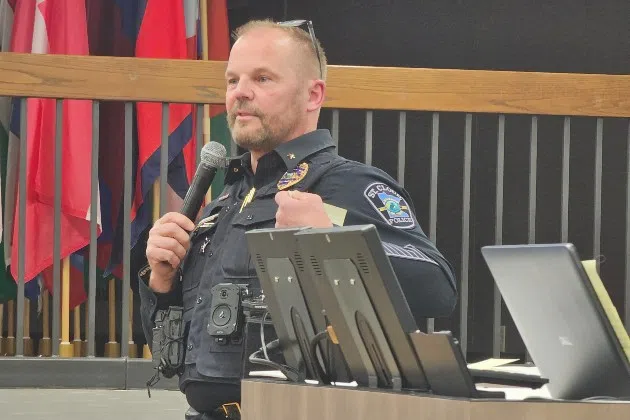
(KNSI) – More than 100 residents packed city hall for the yearly review of the St. Cloud Community Policing Agreement in the wake of recent Immigration and Customs Enforcement operations.
During Wednesday’s meeting, St. Cloud Police Chief Jeff Oxton and Higher Ground Church of God in Christ Pastor James Alberts took questions from the crowd via sticky notes and answered as many as they could. Many were focused on the department’s relationship with ICE and how they responded while more than 60 federal agents roamed the city starting in December.
Oxton described the last few weeks to KNSI News as unlike anything he has seen in his 31-year career. “None of us have seen what we saw happen across the state. In this case we were just out of the loop. It’s difficult to even answer some of the questions that are asked when nobody told me what they were doing.”
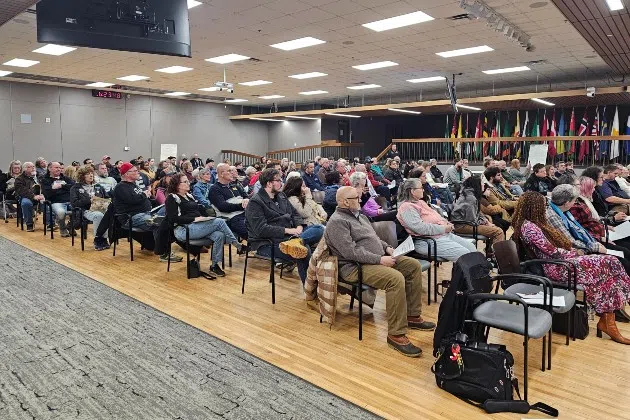
Jake Judd/KNSI News
In the past, Oxton says collaborations with federal agencies, including ICE, would consult with local law enforcement, include them in planning, and give them the opportunity to weigh in on how operations were carried out safely.
Residents wanted to know why police didn’t do anything when ICE agents wore masks and drove vehicles without license plates and dark tinted windows, things the average citizen would get in trouble for. Oxton explained that law enforcement is permitted to wear masks, and many local officers on the SWAT team and who work undercover also wear masks when wearing the uniform. Federal agents said they wore masks after protesters started posting their home addresses online, leading to their families being harassed and threatened.
The agreement states the St. Cloud Police Department will cooperate with U.S. Immigration and Customs Enforcement as it would any other law enforcement agency. It is the policy of the St. Cloud Police Department that its officers shall not arrest or detain any person solely for a suspected violation of immigration laws, except upon request of or when assisting ICE.
Oxton said the next step is forming a subcommittee to review and potentially update the immigration-specific language in the agreement. “We need to develop that subcommittee to go out and start looking at what we want to do now, having lived through this time, with specifics to immigration. And that is a specific section of the agreement.” He added the goal is to have a better playbook in place if something like this happens again. No changes were finalized at the meeting.
On the question of complaints filed related to ICE operations, Oxton confirmed the department received several and has referred them to federal authorities. Two involving possible use-of-force or assault allegations have been sent to the Office of the Inspector General through Homeland Security Investigations. One person has already been interviewed by a federal agent, and the department is still working to reach a second complainant.
He also credited the Community Policing Agreement for helping keep protests peaceful during a volatile stretch. Officers who responded to demonstrations reported being thanked by protesters. “When we had protests here, they were peaceful. When our cops had to go to protests because of calls, we were received well by the protesters, and they listened to us. They went where we told them they could go, and we didn’t have damage or violence.”
Oxton closed by acknowledging that the crowd represented genuinely different viewpoints on a hard issue, and said that’s the whole point. “We brought a lot of people together that had different views of a very difficult situation. We were able to talk through locally how we approach these things and locally what we need to be aware of.”
Despite the tension, he pointed to his department’s track record as evidence that the St. Cloud Police Department remains focused on public safety for all residents regardless of immigration status. The department’s fugitive task force made 130 arrests of individuals wanted for dangerous crimes without a single violent incident, and officers made 500 warrant arrests last year, 300 of which were felonies.
Oxton also took time to clarify something many people misunderstand about the Community Policing Agreement itself. Despite its formal appearance and the fact that it’s signed, it is not a legally binding contract. It’s a written commitment so the principles it contains wouldn’t be forgotten, and signed to show mutual dedication to those principles.
Read the community agreement by clicking here.
___
Copyright © 2026 Leighton Media. All rights reserved. This material may not be broadcast, published, redistributed, or rewritten, in any way without consent.





FOLLOW US FOR INSTANT UPDATES!


FOLLOW US FOR INSTANT UPDATES!