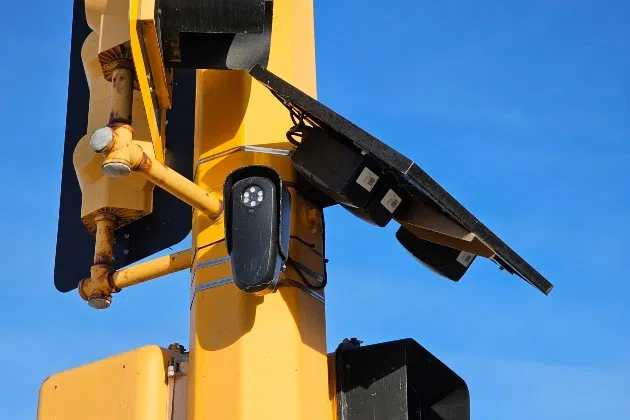
(KNSI) — Solar-powered cameras mounted on light poles at various intersections around St. Cloud have been popping up lately, fueling rumors about their purpose and who has access to the data they collect.
The St. Cloud Police Department is working to clear up what they call misconceptions about the cameras.
Commander Adam Meierding explained to KNSI News that the technology from Flock Safety landed on their radar in 2023 at a conference. The city installed five of them in early 2024, with all units operational by spring. Four cameras were installed at the intersection of 9th Avenue South and University Drive, along with another at the intersection of 5th Avenue South and 1st Street South.
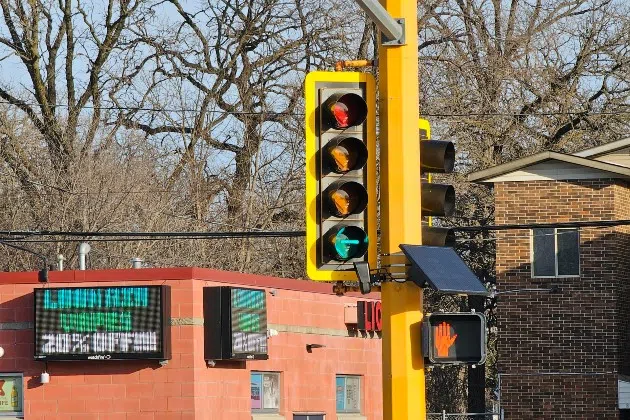
Jake Judd/KNSI News
St. Cloud isn’t the only local community with these cameras. In the fall of 2023, Sartell approved the installation of eight of them. The locations are at County Road 1 and County Road 120, Riverside Drive at Le Sauk Drive, Pinecone Road at Troop Drive, 1st Street Northeast at 14th Avenue Northeast, 6th Street South at 19th Avenue South, Riverside Avenue North at 27th Street North, Pinecone Road at 35th Street North and 2nd Street South at Pinecone Road. Sartell Police Chief Brandon Silgjord explained why they were placed where they were. “If you were to map those locations out, it covers all the ingress/egresses for our city. So any vehicles entering or leaving our city are largely covered by those locations.”
Flock sells its cloud-connected cameras to police departments and customers across the nation. The cameras contain an Automatic License Plate Reader, or ALPR. Plates are run through the National Crime Information Center system, which checks for active stolen vehicles, Amber alerts, missing persons, missing juveniles, and vehicles associated with outstanding warrants.
According to Meierding and Silgjord, the system, along with reading plates, also flags vehicles registered to drivers with suspended or revoked licenses. While Flock has expanded capabilities in other jurisdictions, including vehicle fingerprinting by color, make, model, and even bumper stickers. The system focuses on license plate detection tied to active law enforcement alerts. They say the cameras do not detect facial recognition, people, gender, or race.
Flock recently released its Aerodome software that can launch drones to follow vehicles in some jurisdictions, but St. Cloud and Sartell do not have that capability.
The most pressing concern for many residents responding to online posts has been whether federal agencies, particularly Immigration and Customs Enforcement, have access to the information. Meierding says the city owns all of the data. “I know that in the news right now [there are worries] about agencies sharing the data. We decided early on that we’re going to keep our data and that if somebody wanted access to license plate information, they would need to formally request it from our agency, and then we determine if it’s for a legitimate law enforcement purpose or if it needs a search warrant.” For both the Sartell and St. Cloud police departments, officers need a legitimate law enforcement purpose to access the data.
Minnesota has some of the strictest laws in the country governing license plate readers, according to the Minnesota Revisor’s Office. Along with requirements for short data retention periods, there are stringent laws surrounding data handling, public transparency, and mandatory audits to prevent mass surveillance and ensure accountability.
Both police departments operate under state statutes and internal policies that include a data retention period, under which all data is automatically deleted after 30 days unless it’s related to an active criminal investigation. There is also a ban on selling data to third parties, indefinite logging of all system access, and an officer or dispatcher must personally confirm that a person or property identified by the system is indeed the correct match and that any related search warrants or stolen property reports are still active and valid before officers can take any action.
Regarding ICE concerns specifically, Meierding explains, “As far as I know, we have not received any of those requests from them,” adding that ICE does not have direct access to the Flock system in St. Cloud. This aligns with statements from St. Cloud Mayor Jake Anderson, who confirmed to KNSI News that the city has not received any requests from ICE for camera data and that ICE has not been active in St. Cloud in recent months, unlike the Twin Cities. Silgjord also stated that there have been no requests for Flock data from ICE in his department.
When asked what his message would be to concerned residents, Meierding said, “Yes, we are capturing data, but it’s based on the law. We’re committed to public safety and using technology to help us with our public safety efforts. And if we could get one Amber alert or one missing person or stolen vehicles off the streets, I think that’s a big win for the community.”
Chief Silgjord called the Flock system a law enforcement amplifier and gave a recent example of how it helped them. “We were searching for a burglary suspect, and we had photos and video footage of a suspect vehicle, but we couldn’t get the plates off of surveillance camera video. This vehicle, in particular, [had] a very recognizable dent in the side, and with the Flock system, we found the vehicle, perfect match.”
According to Flock Safety’s public transparency portal for St. Cloud, the system detected 77,928 vehicles in the last 30 days, generated 3,590 immediate notifications, which included everything from driving after suspension to stolen vehicles, and St. Cloud police conducted 14 searches during that same period.
Residents can visit the Flock Safety Transparency Portal, review St. Cloud Police Department policies available on the city website here, or contact the St. Cloud Police Department directly with questions or concerns.
While the Sartell Police Department doesn’t have a transparency portal, the chief says they may consider one in the future.
___
Copyright 2025 Leighton Media. All rights reserved. This material may not be broadcast, published, redistributed, or rewritten, in any way without consent.






FOLLOW US FOR INSTANT UPDATES!


FOLLOW US FOR INSTANT UPDATES!