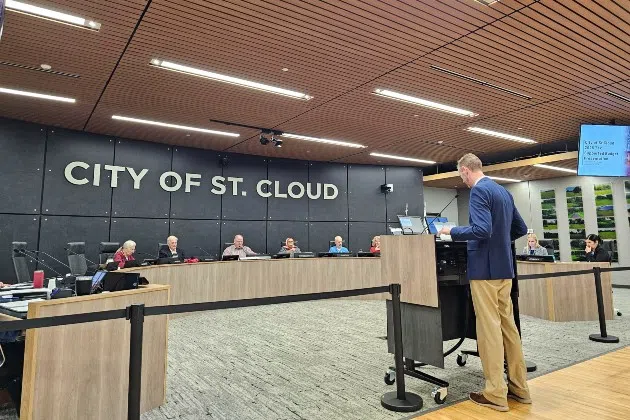
(KNSI) — The St. Cloud City Council unanimously approved next year’s $100.8 million budget Monday night, which includes the first property tax increase in two decades.
The 4.49% tax increase represents a significant shift in the city’s financial philosophy under Mayor Jake Anderson, who was elected in 2024. Anderson explained that the previous approach of limiting spending hikes to match rising property values created a $3.2 million deficit. Without action, the city faced cutting 30 positions, implementing hiring freezes, and reducing service levels.
Around 20 residents spoke during the truth in taxation hearing, with many expressing frustration over property tax bills that have increased between 20% and 36%. Several older residents on fixed incomes said their property taxes have nearly doubled over the past five years, with some fearing they’ll be taxed out of their homes. Council President Mike Conway acknowledged the difficulty of the decision but said years of deferred maintenance left the city with few options. “We kind of inherited a leaky roof in some areas, and you got to fix it when you can.”
Conway explained he’s feeling the pinch, too. “It’s the hardest vote we ever have to take, and I don’t like it. My taxes went up almost 20% like everybody else’s. And it’s just one of those things that if we don’t do it now, deferring it another year is not going to make it easier, and it’s not going to make it better.”
He emphasized that multiple factors contributed to this year’s perfect storm of tax increases. “The fire hall that was voted in is now hitting the taxes. The school district, their referendum is hitting the taxes. The county and the school districts are all raising taxes to keep up with what they need.”
Conway noted some of the city’s needs are substantial. According to records, 58% of St. Cloud’s equipment and vehicles are long overdue for replacement, representing a massive backlog from two decades of deferred maintenance. He pointed to the city’s sole snowblower for the downtown district, which is almost 40 years old. “If it goes, how are we going to get the snow out of downtown? Those are some of the things that we’re up against.”
For years, savings were used to avoid tax increases, but those reserves have nearly been depleted. The fund balance is approaching the 40% threshold required to maintain the city’s AA+ bond rating, which allows St. Cloud to borrow at favorable interest rates.
The approved budget pauses park upgrades from a 2022 referendum, with those improvements resuming in 2027. A facilities assessment will be conducted in 2026, and the city will review permit and service fees to ensure it is recovering actual costs.
Several new positions will be added, including roles in human services, finance, building inspection, public safety, health inspection, and forestry management to address the emerald ash borer threat.
When asked whether residents should expect annual tax increases going forward, Conway expressed hope that this would be a one-time adjustment. “I would like to believe that we’re doing the bare minimum to get things caught up so that we’re comfortable in the equipment that we have and the services we’re providing.”
Beyond property taxes, residents will also see changes in utility rates and fees as the council approved the $67.5 million enterprise funds budget, which covers nine fee-based services, including water, sewer, parking, and garbage collection.
The most significant change affects the water utility, which will increase by approximately $3 per month for average users who consume 6,000 gallons per month. The increase addresses upcoming infrastructure projects and declining reserves that would have created a $2 million shortfall next year.
In a move to encourage downtown visits, nearly 3,000 parking spaces in ramps and surface lots will be free after 5:00 p.m. and on weekends. On-street meter parking will increase by 50 cents to $1.50 per hour, and parking permits will rise by 10%. Conway defended the changes as part of an ongoing effort to simplify the system.
Trash collection fees will increase by $1 per month to $32.50 for cart users, though green bag users will see no change. Compost permits are rising from $30 to $40, with a new non-resident fee of $80. Special pickups will increase from $20 to $25.
The new budgets take effect January 1st.
___
Copyright 2025 Leighton Media. All rights reserved. This material may not be broadcast, published, redistributed, or rewritten, in any way without consent.



FOLLOW US FOR INSTANT UPDATES!


FOLLOW US FOR INSTANT UPDATES!