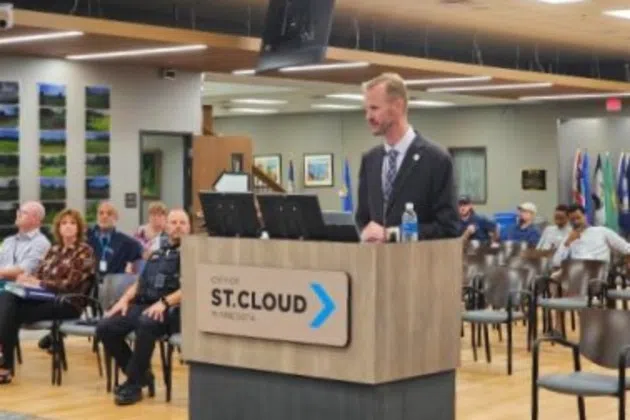
(KNSI) — “It’s not a fun budget,” St. Cloud Mayor Jake Anderson told KNSI News shortly after proposing the first property tax increase in 20 years to cover the cost of city services.
The city council is reviewing a proposed $100.88 million budget for 2026, which represents a 13.4% increase from this year. To help pay for it, the city will need to raise property taxes by 4.49%. That would cost homeowners an extra $120 a year on a $300,000 home. When adding the increase from the approval of a new fire station in November, the total comes to $412 a year.
Anderson explained that the city’s old approach of limiting spending increases to match rising property values has created a financial hole. “If we don’t change philosophies, we were looking at about a $1.6 to $1.8 million capture of the growth. Our expenses went up about $4.8 million. We have a deficit of $3.2 million. The only way you close that is cut services, cut spending, cut employees, or look to raise the tax rate.”
If the city takes no action, it faces escalating repair costs and would need to cut up to 30 staff positions across departments. The city would also implement hiring freezes and reduce service levels, leading to slower response times for code enforcement and possibly police calls. Money is also needed to cover inflation and pay increases for staff and benefits.
Anderson’s vision is to switch to making strategic investments and promoting fiscal sustainability. “We need to be smart in what we’re doing, and we need to ensure that we’re budgeting appropriately and that we’re managing our budget. I don’t want to get out ahead of our skis, but we’re going to start trying to build out five year projections of where we’re at and revenue that we need and how we plan on doing it. And property tax is obviously part of that formula.”
Another approach he suggested is to grow the city’s economy over time by attracting more businesses and industries, thereby expanding the tax base.
The city has been using its savings account to avoid tax increases for years, but that has nearly emptied the reserves. The fund balance is dangerously close to dropping below the 40% threshold required to keep the city’s high bond rating. That AA+ credit score allows the city to borrow at the best interest rates, saving taxpayers money on projects.
There are also pressing infrastructure needs that have been put off for years. According to city records, 58% of the city’s equipment and vehicles are overdue for replacement, representing a massive backlog of deferred maintenance from the past two decades.
“So it’s either, in a way, pay now or pay later. Not that I want as my first year as mayor to be raising taxes, but I think it’s fair to be open and honest with people and not kick problems down the road. And I think that’s what we’ve been doing.”
The spending plan also calls for pausing park upgrades approved by voters in a 2022 referendum. Those improvements would resume in 2027.
A facilities assessment will be conducted in 2026 to ensure city buildings are up to date, and there will be a review of permit and service fees to make sure the city is recovering the actual costs of providing those services.
Anderson says they’re not necessarily expanding city government, but rather trying to fund the maintenance of what the city already has. However, the budget does include some new positions to address critical needs.
The city could add a human services director to help with hiring across departments. They currently have two HR managers, and the department heads are largely responsible for hiring. Anderson said it was the biggest concern he heard from department heads when he asked what they needed.
Other planned additions include an assistant for the finance department, a building inspector, a police sergeant, a health inspector, and an arborist. The arborist position is needed to prepare for the emerald ash borer, an invasive pest discovered in the city a couple of years ago that threatens St. Cloud’s 40,000 to 50,000 ash trees.
There will be a public hearing at the September 8th city council meeting, where residents can comment on the spending plan. The council will vote on the preliminary budget on September 22nd. Once set, that becomes the maximum tax rate and can only go down from there.
The final budget will be adopted in December.
___
Copyright 2025 Leighton Media. All rights reserved. This material may not be broadcast, published, redistributed, or rewritten, in any way without consent.


FOLLOW US FOR INSTANT UPDATES!


FOLLOW US FOR INSTANT UPDATES!