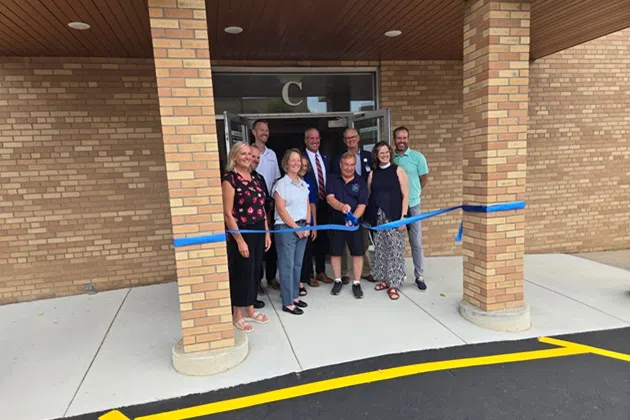
(KNSI) – St. Cloud opened its third Community Outpost on Thursday, cutting the ribbon on its east side location inside Salem Lutheran Church.
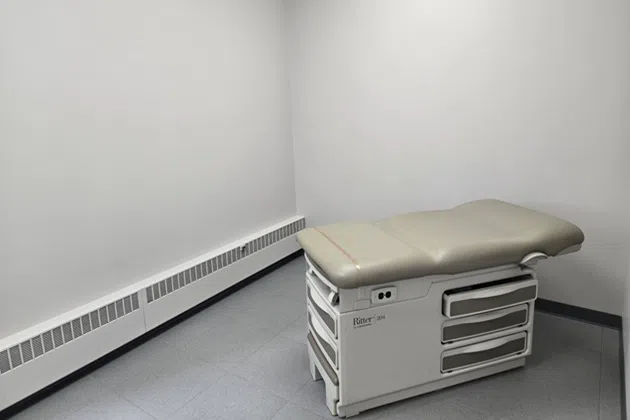
The neighborhood’s demographics contrast sharply with the other COP House neighborhoods, and the services it provides are being tailored to meet those differences. On the first floor, nursing students from the College of St. Benedict and St. John’s University will provide a free walk-in clinic. It will begin operations by the end of August.
The clinic will be manned by one faculty member and two students to start, with the hope of expanding to as many as six students later on. The clinic is scheduled to be open on Monday and Wednesday afternoons in the early months.
Instructor Mary Zelenak says the arrangement is critical in helping the school ensure its students meet graduation requirements. “Our students, in their senior year, have this public health clinical rotation. Each student is required to have 40 hours.”
Both undergraduate RN students and graduate family nurse practitioner students will be involved in the clinic. It is designed to serve as an entry point to the healthcare system for individuals who have been excluded due to economic or other reasons. Instructor Rachelle Larson states, “Our goal, really here, is if someone comes to see us for an illness that’s a one-time illness, great. If they need additional care, our goal is to get them hooked up to the care that they need, with a primary physician or provider.”
Students will gain invaluable experience in a way that goes beyond what other clinicals provide. Student Alaynna Kriz has been on-site this summer helping prepare how the clinic will run. She echoes Larson in talking about how this clinic will be a different, deeper test. “These nursing students are going to have to learn to use the full scope of an RN. You’re going to be a teacher, and you’re going to have to listen with the ear of your heart and really hear these people and where they’re coming from. I think that’s so different than any other clinical we have.”
Kriz differentiates that from getting time in a delivery room with OB/GYNs, saying labor nursing is “so fast and so quick. And you see your patient for maybe a couple hours, and you’re gone, and then they move on with their healthy baby. And you go back to class…Any of these other older adult clinicals, you go there, you hang out for a couple days, and then you’re gone.”
Kriz concludes, “This clinic is…you’re in their home. This is their neighborhood, this is their church, this is their area. You’re coming to them, you’re meeting them where they’re at, and that’s so different than being in a hospital.”
Grant Dossetto/KNSI News
Already, off-site visits are planned at the nearby Riverside Apartments. Larson and Zelenak expect their students to become active parts of the community quickly.
Healing of both the body and the mind will be focused on at the COP House. On the second floor will be a unit run by the St. Cloud Police Department. Sergeant Tad Hoeschen is part of the Community Engagement Division, which has several specialty groups under its command. “I have three units within the Community Crisis Intervention Team, and one of those is the Mental Health Response Unit, which is made up of a collaborative approach between two police officers from St. Cloud Police Department, two social workers, or master’s level social workers from Central Minnesota Mental Health Center, and two community paramedics from Mayo Ambulance Service.”
The Mental Health Response Unit has seen its workload soar in recent years, according to Hoeschen. “In 2024, that team of six people and one dog responded to 880 mental health calls for service just in the city of St. Cloud, and we’re on pace to be at more than 1000 calls for service this year.”
Hoeschen has thoughts on what is causing the surge, pointing to polarization in society and divisions between residents that are leaving us isolated. “There’s so many things they see on social media or just the disparaging opinions of our neighbors that we either are for something or against something. And it’s hard for us to find any sort of comfort when we’re having a conflict or anything, and sometimes it feels like we’re all alone.”
Former unifying institutions, such as churches or fraternal groups, no longer have the same influence they once did. For those falling through the cracks, they’re on their own. And Hoeschen says they are desperate, as some of their problems were inherited from their family. “Trauma lives in our DNA for four generations. You may not even be able to describe why you’re feeling what you’re feeling, but in the last five years, with all the different things we’re seeing in our country, in our world, and all the different conflicts that are happening, it’s harder for people to process that.”
Hoeschen exclaims that the phrase “medicine is as much an art as it is science” applies even more to his work in mental health response. “It’s not a science. I can’t tell you what a person has been through five minutes before I have interaction with them, five hours, five weeks, five years, five lifetimes. I can’t tell you what it is that person is going to need, but I can sit and listen.”
To make the line even finer, Hoeschen notes that listening only goes so far. He has to walk a tight rope that avoids having someone wallow in their current miseries or suicidal thoughts. Hoeschen and his officers have to find a way to give someone a greater purpose.
Often, that is done in unique ways that go outside the box. He uses the following example. “Our team has actually come up with some creative solutions before, where we’ve identified the proper person for it, and we brought them to the Humane Society and helped them adopt a pet, because they just need something bigger than themselves. We had a woman that was calling six to seven times a week for a mental health crisis. We got her a cat, and it stopped.”
The Mental Health Response Unit has its own pet secret weapon. River, a golden lab therapy dog that was acquired from a breeder in Milaca, has a kennel at the East End facility. He’ll be available to pet, in which he is eager to take in as many as possible, and he offers attention without judgment to help work through problems. River has gone to area homeless shelters and helped in the community, but he is also a resource for officers dealing with stress from the job. Expect him to be a key cog in future success.
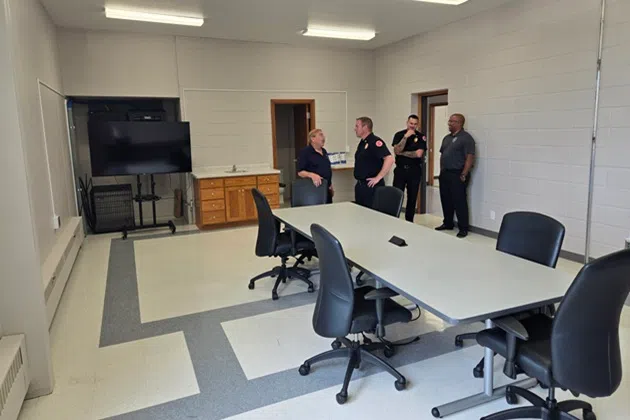
There are plenty of other organizations that will play a big role in the East End COP House’s effectiveness. Many were on hand Thursday, including representatives from CentraCare, Benton County, and more. Right now, the interior of the wing off Salem Lutheran Church is pretty sparse. The outlines of a care room, a classroom to deliver health services education, and a gathering space are there, but the fine details have been left out. That was by design, as with so many groups using the building, it will be trial and error before officials know exactly how to maximize the facility.
Grant Dossetto/KNSI News
___
Copyright 2025 Leighton Media. All rights reserved. This material may not be broadcast, published, redistributed, or rewritten, in any way without consent.




FOLLOW US FOR INSTANT UPDATES!


FOLLOW US FOR INSTANT UPDATES!