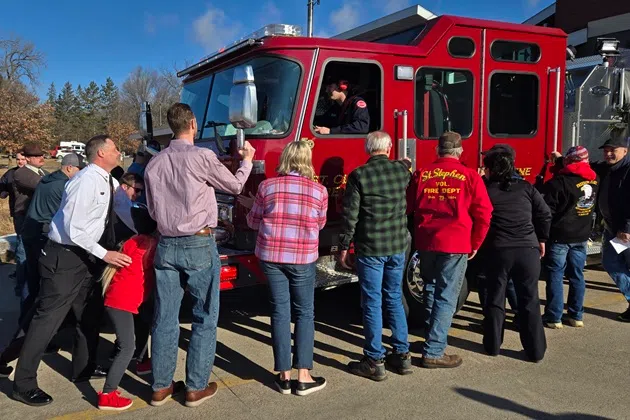
(KNSI) – The time-honored tradition of a push-in ceremony was held at St. Cloud Fire Station 5 Thursday morning to welcome a brand new fire engine.
The ceremony dates back to the 1830s when a new apparatus came to a fire hall. It would arrive on a trailer hitched to horses, dropped, and then manually pushed into its bay where it would await the next call. This new rig took firefighters, elected officials and the community to roll up their sleeves and give it a good nudge.
Battalion Chief Brett Young says the push-in ceremony is a great way for department personnel and residents to celebrate the addition. “We try to do it when we get a new vehicle. It’s a great way to bring the community together, along with fire department and elected officials, and it’s something unique for the fire service that we can celebrate, something that’s new to us and new to the community that’s going to serve them for a long time.”
The roughly 56,000-pound vehicle will get plenty of use. The St. Cloud Fire Department handles about 10,000 calls a year. Fire Engine 5 is unique in that it carries 1,000 gallons of water, which is twice the water of what the city’s other trucks can carry. It also has a top mounted pump panel which allows for quicker deployment of lines and hoses as the operator has a better view for what is being pulled out and can get water going to the correct place.
While the engine truck was the star of the ceremony, another recent delivery also got time in the spotlight. St. Cloud is the region’s only department that handles hazardous material response. The new hazmat truck is loaded with brand-new technology. Young explains there are “video cameras all around the vehicle. The hazmat truck, for instance, has TVs in there. We have live feed video cameras in there. We can communicate, obviously, with Bluetooth and so forth. It’s instant right now, and ten years ago, we didn’t have any of that capability.”
Young adds the tech upgrades make a dangerous job safer. He pointed out that operators can stake meters in the ground and get up-to-date contamination data if winds shift rather than sending someone out to take the readings with a handheld device and risking exposure. Every St. Cloud firefighter has hazmat certification and can go on calls so that the station is properly staffed for potential emergencies here at home, or when there is a call out on the other side of the 11-county region St. Cloud is responsible for.
Vehicles have been on backorder for at least four years, meaning delivery is the end of a long, complicated process. Young points out that market conditions make maintenance and other preventative care even more important to the department’s success.
“The preventative side of what we do is what keeps our trucks on the road and last as long as they do. But we also know that we’re putting a lot of hours on our trucks, and we do a lot of calls, and that also creates more maintenance and oil changes and tires and brakes and so forth, so routine things, just like a vehicle…your personal car, we also have going on with those trucks.”
Trucks are inspected daily and meticulous maintenance records are also kept. Those help extend the service life of engines to around 15 years.
___
Copyright 2025 Leighton Media. All rights reserved. This material may not be broadcast, published, redistributed, or rewritten, in any way without consent.





FOLLOW US FOR INSTANT UPDATES!


FOLLOW US FOR INSTANT UPDATES!